

m1000 firecracker
Price range: $60.00 through $550.00
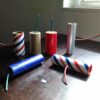
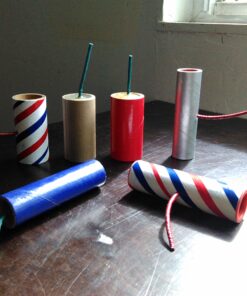
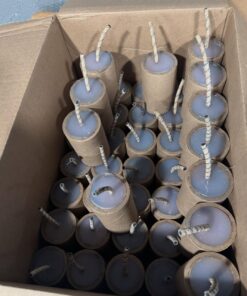
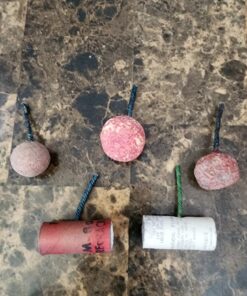
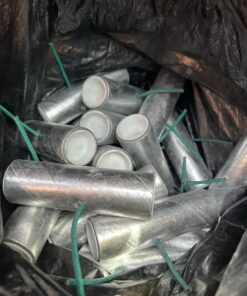
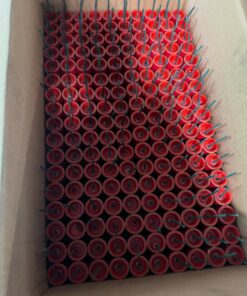
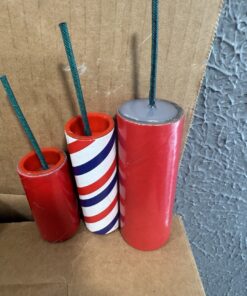
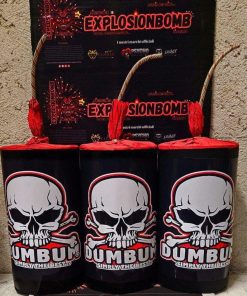
The M1000 is typically a thick cardboard tube, often red or silver, with a fuse sticking out of the side or end. Despite the name suggesting a bigger cousin of the M-80, there’s no standardized “M1000” product. The label is a street name used by clandestine makers, which means the contents vary wildly from one device to the next.
The M1000 firecracker and the strobe rocket sit at opposite ends of the pyrotechnic spectrum, even though both get lumped together on July 4th and New Year’s Eve. One is built to make a single, violent bang. The other is built to climb, flicker, and draw the eye across the sky for several seconds.
That difference matters more than most people realize. One of these products is a legal consumer firework in many places. The other is, in the United States and much of the world, classified as an illegal explosive device rather than a firework at all. Every year, emergency rooms treat injuries from devices like the M1000, and the people hurt were often convinced they were holding a “big firecracker.”
This comparison covers how each device works, what you actually see and hear, how regulators treat them, and why professional display operators make the choices they do. If you’ve been curious about the hype around the M1000, or you’re weighing what belongs in a show, this should give you a clear-eyed picture.
Core Mechanics: Explosive Power vs. Sustained Propulsion
The basic split comes down to timing. A firecracker like the M1000 releases its energy in a fraction of a second, while a strobe rocket meters its energy out over a few seconds of flight and effect. Everything else, from sound to risk profile, follows from that one design choice.
The m1000 firecracker Design and High-Decibel Impact
The M1000 is typically a thick cardboard tube, often red or silver, with a fuse sticking out of the side or end. Despite the name suggesting a bigger cousin of the M-80, there’s no standardized “M1000” product. The label is a street name used by clandestine makers, which means the contents vary wildly from one device to the next.
What they share is a confined charge of flash powder. When the fuse burns down, the powder ignites almost instantly, pressure builds inside the sealed tube, and the casing ruptures. That rupture is the bang, and because there’s no lift charge or effect, the device does its work wherever it happens to be sitting.
This is why the M1000 is dangerous in a way ordinary firecrackers aren’t. There’s no delay you can count on, no predictable fuse length, and no buffer between the explosion and anyone nearby. Fuses on illegal devices have been reported burning in a second or less.
The Strobe Rocket Flight and Oscillating Burn
A strobe rocket works on a completely different principle. A motor of compressed propellant burns steadily, pushing the rocket upward while a stick or fins keep it pointed in roughly one direction. The goal is controlled thrust, not containment and rupture.
Once the rocket reaches altitude, or sometimes during the climb itself, strobe composition ignites. Strobe mixtures are designed to burn in pulses: they flare brightly, smolder dimly, then flare again. That oscillation produces the rapid flashing effect that gives these rockets their name.
The result is a device that spends its energy over distance and time. By the time the visual effect peaks, the rocket is well above the launch site, which is the entire point of the design.
Visual and Auditory Experience Comparison
If you’ve ever stood near an M1000 going off, you’ll remember the sound more than anything you saw. There’s a bright flash, a concussive boom you feel in your chest, and a cloud of smoke and shredded paper. The whole event lasts about as long as it takes to blink.
Strobe rockets give you almost the reverse experience. Here’s how the two stack up side by side:
| Feature | M1000 Firecracker | Strobe Rocket |
|---|---|---|
| Primary effect | Single loud report | Flickering light in the sky |
| Duration | Under one second | Roughly 2 to 6 seconds of effect |
| Sound | Sharp, concussive blast | Whistle or hiss on ascent, crackle during strobe |
| Visual interest | Brief flash, smoke | White or colored pulsing lights, often in clusters |
| Viewing distance | Felt up close, heard far | Best viewed from a distance |
| Audience appeal | Shock value | Visual spectacle |
The audience reaction tells you a lot. A loud report gets a startled jump and maybe a laugh. A strobe rocket bursting into a cloud of glittering flashes gets people pointing and pulling out their phones.
There’s also the question of who else hears it. Concussive blasts carry for blocks, upset pets and neighbors, and can be mistaken for gunfire. Strobe effects are quieter by comparison, though rockets still produce a noticeable whoosh and crackle. If you care about the people around you, the difference in noise footprint is significant.
Safety Protocols and Regulatory Classifications
This is where the comparison stops being about preference. The two devices aren’t just different products; they occupy different legal categories, and handling one like the other is how people get badly hurt.
Consumer Grade vs. Restricted Pyrotechnics
In the United States, consumer fireworks (classified as UN0336, 1.4G) are limited in how much explosive composition they can contain. Firecrackers sold legally to consumers are capped at 50 milligrams of powder. Devices sold as M-80s, M-100s, quarter sticks, and M1000s exceed those limits by a wide margin, which is why federal agencies treat them as illegal explosive devices, not fireworks.
That classification carries real consequences. Making, selling, or possessing these devices can bring federal and state charges, and law enforcement agencies regularly issue warnings ahead of holidays. Some cities run amnesty programs where people can surrender them without penalty.
Strobe rockets, by contrast, are commonly sold as consumer fireworks where state and local law allows rockets. Larger, professional-grade versions fall under display fireworks (1.3G) rules and require licensed operators. A few practical points:
- Check your state and local laws first. Many jurisdictions ban aerial devices, including rockets, even if they allow fountains and sparklers.
- Buy only from licensed retailers. Legitimate products carry labeling, warnings, and manufacturer information.
- Treat any unlabeled “M” device as illegal. If it lacks proper labeling and looks homemade, don’t light it, and contact local police or the fire department about safe disposal.
Launch Trajectory and Blast Radius Management of m1000 firecracker
For strobe rockets, the main hazard is direction. A rocket that tips over, launches from a soft surface, or gets fired near structures can travel sideways at speed. Safe practice means launching from a stable tube or rack on flat ground, angled slightly away from spectators, with clear overhead space free of trees and power lines.
Spectator distance matters too. A common recommendation for consumer aerial items is to keep viewers at least 35 to 50 feet back, and more for larger rockets. Never relight a dud; wait at least 20 minutes and then soak it in water.
The M1000 doesn’t have a trajectory to manage. Its risk is the blast itself, along with fragments of the casing. There is no safe “blast radius” practice for an illegal device of unknown contents, which is why the honest safety advice is simply not to use one. Most serious hand, eye, and facial injuries tied to these devices happen to people who thought they had enough time to step back.
Chemical Composition and Manufacturing Differences of m1000 firecracker
At a high level, the chemistry explains the behavior. Flash powder, used in illegal firecrackers like the M1000, is a mixture of a strong oxidizer and a fine metal fuel. It burns extremely fast, and when confined it transitions to an explosion. It’s also notoriously sensitive to friction, static, and impact, which is why clandestine manufacturing operations have a long history of accidental explosions and deaths.
Rocket propellant is formulated for the opposite goal: a slow, steady burn. Traditional rockets rely on black powder pressed into a motor with a carefully shaped core, so the burning surface produces consistent thrust. Strobe stars use separate compositions engineered to pulse rather than burn evenly, often with metal salts added to produce white, red, green, or other colors.
The manufacturing gap is just as wide as the chemical one:
- Quality control. Legitimate rockets come from licensed factories with batch testing and consistent fuse timing. Illegal firecrackers come from unlicensed makers with no testing at all.
- Labeling. Consumer and display products carry warnings, classification codes, and manufacturer details. An M1000 usually carries nothing useful, or misleading branding.
- Consistency. Two strobe rockets from the same case will behave nearly identically. Two M1000s from the same seller might contain very different amounts of powder.
That inconsistency is arguably the most dangerous trait of the illegal device. You can’t make informed safety decisions about something whose contents you can’t know.
Choosing the Right Firework for Professional Displays
For licensed display operators, this choice is easy: the M1000 isn’t an option. Professionals work with classified display products from known suppliers, fire them electronically from a safe distance, and follow fallout zones and permit conditions set by local authorities. No permit authority would sign off on illegal explosives, and no reputable insurer would cover the show.
Strobe effects, on the other hand, are a staple of professional work. Choreographers use them as accents, filling gaps between larger shell bursts or punctuating musical beats. Some practical considerations when building them into a show:
- Placement. Strobes read best against dark sky, so they often work well as transitions after brighter shells fade.
- Color pairing. White strobes pair nicely with gold or silver effects; colored strobes can echo a show’s theme.
- Noise planning. For venues with noise limits, strobe-heavy segments deliver visual impact without the heavy reports of salutes.
- Timing. Electronic firing lets operators synchronize strobe bursts with music to within fractions of a second.
When a show genuinely needs a loud report, professionals use display salutes: legally manufactured, classified, and fired from mortar racks well away from the audience. That’s the legitimate version of the “big bang” people chase with illegal firecrackers, and it lives entirely in licensed hands.
For anyone weighing these two devices, the comparison resolves cleanly. The strobe rocket is a legitimate firework designed to deliver light and motion at a safe distance, and with proper launch practice it belongs in both backyard celebrations (where legal) and professional displays. The M1000 is a mislabeled explosive with unpredictable contents, a dangerously short fuse, and serious legal consequences attached to it.
If you want spectacle, rockets, strobes, and properly classified aerial products will give you far more to look at than a single bang ever could. If you want noise, leave it to licensed operators with salutes and safe distances. And if you come across an M1000, don’t light it: call your local fire department or police non-emergency line and let them handle it. The best fireworks memories are the ones where everyone goes home with all ten fingers. m1000 firecracker
| FIRECRACKER | 10 PIECES, 20 PIECES, 50 PIECES, A BOX |
|---|
Be the first to review “m1000 firecracker”
Related products
FIRECRACKER
FIRECRACKER
FIRECRACKER
FIRECRACKER
FIRECRACKER
FIRECRACKER
Reviews
There are no reviews yet.