

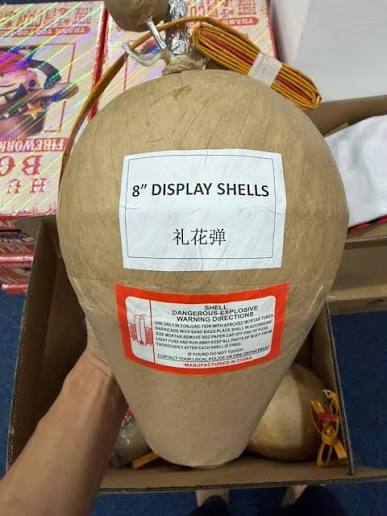

8 inch shell
Price range: $170.00 through $3,500.00
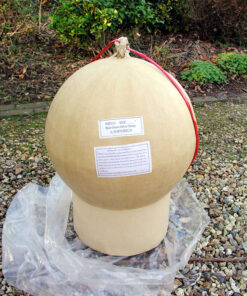
An 8-inch aerial shell is a spherical or cylindrical casing roughly 8 inches in diameter. It is packed with stars and a burst charge and fitted with a time fuse. A lift charge at its base propels it out of a matching mortar tube. The fuse burns during the climb, and when it reaches the burst charge, the shell breaks open at or near the top of its arc.
Few things in pyrotechnics command a crowd like the deep thump of an 8 inch shell followed, several seconds later, by a break that fills the sky. Strobe rockets offer a very different experience: a crackling, flickering trail that climbs and pulses instead of blooming. Choosing between them, or deciding how to pair them, comes down to what you want the audience to feel and what your site and license can actually support.
One point needs to be clear from the start. Shells of this size are professional display fireworks (UN 1.3G in the US). They are legally fired only by licensed operators under permits from the local authority having jurisdiction. Everything below is written for display professionals, show designers, and the people who hire them, not for backyard experimentation.
The Fundamentals of 8 inch shell and Strobe Rockets
An 8-inch aerial shell is a spherical or cylindrical casing roughly 8 inches in diameter. It is packed with stars and a burst charge and fitted with a time fuse. A lift charge at its base propels it out of a matching mortar tube. The fuse burns during the climb, and when it reaches the burst charge, the shell breaks open at or near the top of its arc.
Weight is a big part of the story. A typical spherical shell in this class weighs somewhere in the range of 8 to 12 pounds, and cylindrical versions can be heavier. That mass is why these shells reach burst heights commonly cited in the 700 to 900 foot range. A rough industry rule of thumb is about 100 feet of altitude per inch of diameter.
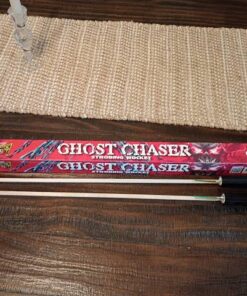
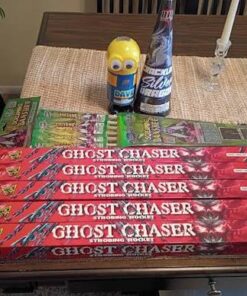
Strobe rockets work on an entirely different principle. They carry their own propellant motor and fly under continuous thrust rather than being fired like a projectile. The strobe effect comes from a composition that burns in rapid, self-interrupting flashes. That produces the signature flickering light along the flight path or in the heading effect. Rockets need no mortar and guide themselves with a stick or fins, but they trade precision for that independence.
Selection Criteria for High-Caliber Display Shells
Buying large shells is not like buying consumer cakes. You are paying for a single moment that lasts maybe three seconds, so every one of those seconds has to earn its cost. Manufacturer reputation, batch consistency, and honest product descriptions matter more here than at any smaller caliber.
Evaluating Break Patterns and Color Quality
The break is the whole point. When you review a supplier’s catalog or test footage, look for these qualities:
- Symmetry: A good peony or chrysanthemum should form a near-perfect sphere. Lopsided breaks usually point to uneven star loading or a weak burst charge.
- Star count and density: Larger shells should show visibly fuller breaks. Sparse coverage at 8 inches means you’re paying premium prices for 6-inch performance.
- Color saturation: Deep blues and true purples are the hardest colors to achieve. A supplier who gets blue right usually handles everything else well.
- Burn time: Stars should burn out together, not trickle away unevenly.
- Specialty effects: Pistils, color changes, and crossettes add complexity. They also add more points of failure, so ask for video of the specific item, not a generic sample.
Structural Integrity and Fuse Timing
A shell that ruptures in the mortar is the most dangerous failure in the business. Inspect cases for crushed paste wraps, split hemispheres, moisture stains, and loose leaders. Reject anything damaged rather than trying to salvage it.
Fuse timing deserves the same attention. A shell that breaks too early, before apogee, spreads stars at lower altitude and closer to the crowd. One that breaks late, on the way down, does the same. Reputable manufacturers publish timing specifications and hold consistent tolerances across batches. If a supplier can’t tell you their delay times, buy elsewhere.
Safe Launch Procedures for Large Diameter Mortars
The most important number for an 8 inch shell is the separation distance. NFPA 1123, the code most US jurisdictions adopt, calls for a minimum radius of 70 feet per inch of shell diameter. That works out to 560 feet from the mortars to spectators for 8-inch product, and local authorities can require more.
Professional launch practice for this caliber generally follows a consistent sequence:
- Mortar selection: Use mortars rated for the caliber. Many operators prefer steel or heavy fiberglass at this size. HDPE is used where rated, and cardboard is not appropriate.
- Secure placement: Bury the mortars or mount them in heavily braced racks, angled slightly away from the audience. An 8-inch mortar shifting at ignition is a serious hazard.
- Electric firing only: Shells are fired remotely from a firing system, with the operator well outside the hazard zone. Hand-firing 8-inch product is no longer considered acceptable practice by most licensed crews.
- Loading discipline: Load shells carefully. Keep your head and body out of the line above the mortar.
- Misfire protocol: Treat any shell that doesn’t fire as live. Crews typically wait a set period, often 15 to 30 minutes per company policy, before approaching. Remove it only according to the display company’s procedure.
The Unique Mechanics of Strobe Rocket Propulsion
A rocket burns its propellant over time, so it accelerates throughout the motor burn instead of all at once in a mortar. That gentler launch is easier on the device, but it makes flight far less predictable. A gust of wind, a slightly bent stick, or uneven propellant can send a rocket off at an angle a shell would never take.
The strobe itself is a chemistry trick. Strobe compositions are formulated to burn in an oscillating way: a dark smoldering phase alternates with a bright flash, often several times per second. The rate depends on composition and pellet size. That’s why some rockets produce a slow, deliberate pulse and others a frantic glitter.
Rockets can carry strobe effects in two places: in the tail as the rocket climbs, or in a heading that releases strobing pellets at apogee. Tail strobes give you a moving line of light that a shell simply can’t match. Headings stay modest in size because rockets can’t carry much payload compared to a heavy shell.
Comparative Performance: Ballistics vs. Visual Effects
Shells and rockets answer different design questions. A large shell gives you a fixed, predictable picture at a known height. A strobe rocket gives you motion, texture, and sound throughout the flight. Most strong shows use both rather than picking a winner.
Altitude and Drift Considerations of 8 inch shell
A large shell’s path is largely set at ignition. Mortar angle, lift charge, and shell weight determine where it goes, and wind mainly affects the falling debris and the drift of the break. That predictability is exactly why separation distances can be calculated cleanly.
Rockets are a different animal. Their altitude varies more from unit to unit, and wind acts on them during the whole powered climb. Weathercocking is a real problem: the rocket turns into the wind, often toward an unexpected direction. For this reason, many operators set stricter wind limits for rocket segments than for shell segments and place rocket stations with downwind fallout in mind.
Acoustic Impact and Rhythmic Pulsing of 8 inch shell
Sound shapes a show more than people expect. An 8-inch shell produces two distinct audio events. First comes the deep mortar thump at launch, then a much louder report or rolling crackle at the break, delayed by the time it takes sound to travel back down. Audiences feel that break in their chest.
Strobe rockets create sound that builds instead of hitting all at once. You hear a whistling or hissing climb, followed by rapid pops or crackles if the strobe is audible. In a choreographed show, that rhythmic pulsing pairs well with fast music. The large shells, by contrast, work as punctuation marks: the cymbal crash at the end of a phrase.
Logistical Requirements and Site Preparation Of 8 inch shell
A display that includes 8-inch product needs a large site, and the planning starts months ahead. Begin with a site survey that measures the full 560-foot minimum radius and identifies anything inside it. Look for structures, parking, trees, overhead lines, and dry vegetation that could catch falling debris.
Permits come next. Most jurisdictions want a site plan, proof of insurance, the operator’s license, and a product list well before the show date. Coordination with the fire marshal is standard. Displays near airports may also require notification to aviation authorities, given that these shells break hundreds of feet up.
On show day, plan for these essentials:
- Fallout zone control: Keep the downwind area clear and assign crew members to patrol it.
- Product storage: Use magazines or approved day boxes, kept separate from the firing line.
- Fire suppression: Have extinguishers and water ready, and stage a fire crew if the jurisdiction requires it.
- Post-show sweep: Search for duds and debris at first light. Unexploded shells remain hazardous.
Rocket stations need their own launch troughs or racks. Keep them separated from mortar rows so a wayward rocket can’t reach loaded tubes.
Choosing the Right Mix for Your Display
The best 8-inch product earns its place through clean symmetrical breaks, honest fuse timing, and solid construction. It delivers its full value only when launched by a licensed crew on a site with room to spare. Strobe rockets fill a different role, with moving trails, pulsing light, and a building soundtrack. They come with more flight variability that demands extra margin for wind.
If you’re planning a show, think in terms of rhythm. Let rockets carry the energy between moments, and save the big shells for the peaks your audience will remember. Then hire an operator who will show you their permits, their site plan, and their misfire protocol before you sign anything. The most memorable display is always the one that ends with everyone heading home safely.
| 8'' inch | 1 PIECE, 3 PIECES, 5 PIECES, 10 PIECES, 25 PIECES |
|---|
Be the first to review “8 inch shell”
Related products
FIREWORKS
FIREWORKS
FIREWORKS
CAKES

FIREWORKS
FIREWORKS
FIREWORKS
Reviews
There are no reviews yet.