
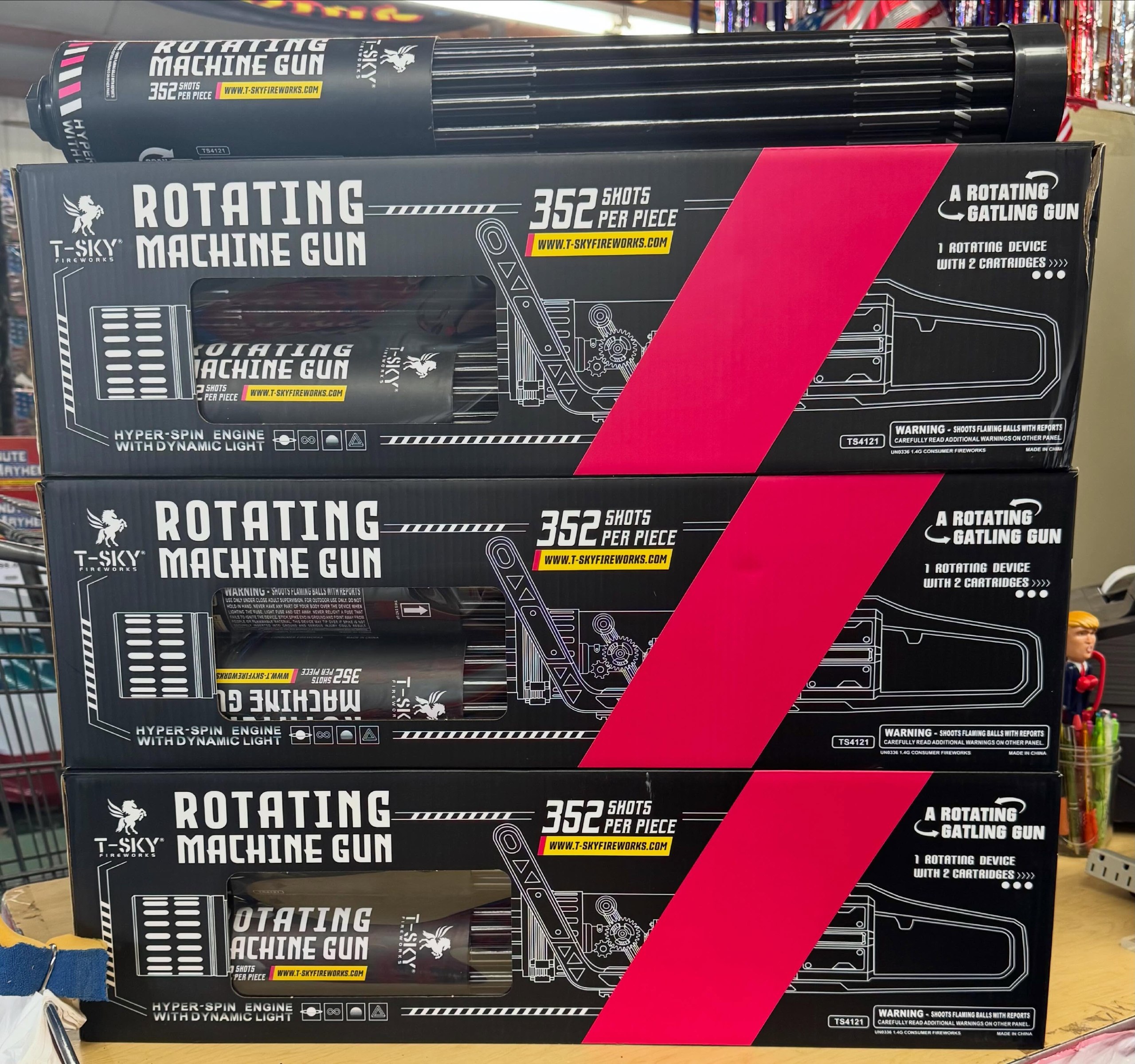
Gatling Gun Firework
Price range: $300.00 through $1,999.00
The core of the show is sound. You’ll hear a fast, crisp rattle, often paired with crackle or small reports at low to medium height. Visually, many models fire comet tails or glittering stars in a sweeping fan, so the sky fills with a wall of light moving side to side rather than big round bursts high above.
Few consumer fireworks get a crowd reacting faster than one that sounds like it belongs in an action film. The gatling gun firework is built around that reaction: a long, rattling burst of shots fired so quickly that the individual pops blur into one continuous roar. If you’ve only heard one from across a field, it’s natural to wonder what is going on inside the box and whether it’s worth the money.
This guide covers how these devices are built, what a typical performance looks and sounds like, and how they compare with the strobe rocket, another popular choice that works in a completely different way. Both appeal to people who want something more dramatic than a basic fountain, but they reward different setups and different audiences. Picking the wrong one for your garden, venue, or neighbours can mean a disappointing show or an awkward conversation the next morning.
By the end, you should know which suits your space, your crowd, and your budget, along with the safety basics that apply to both.
Anatomy and Mechanics of the Gatling Gun Firework
From the outside, most of these products look like an ordinary cake: a squat cardboard block wrapped in printed paper with a single fuse poking out. The difference lies in how the tubes are arranged and how fast the fuse chain moves through them.
The Internal Fusing and Sequential Timing
Lighting the external fuse ignites a chain of fast-burning fuse that links every tube inside the cake. In a standard cake, that chain is often set so shots fire at a steady, readable pace. In a gatling-style cake, the fuse path is shortened and tightened so each tube lights a fraction of a second after the one before it.
That tiny delay is the entire trick. Fire everything at once and you get a single bang; space the shots too far apart and it sounds like a slow drumbeat. Manufacturers tune the gap to land in the zone where your ear hears a rapid, machine-like rattle rather than separate explosions.
Multi-Tube Design and Rapid-Fire Propulsion
Inside, you’ll typically find many narrow tubes packed tightly together. Narrow tubes hold smaller lift and effect charges, which is why each shot is modest on its own and why the cake can hold so many of them.
Many designs angle the tubes in rows, so the shots sweep left to right or fan outward as the sequence runs. Each tube has a small lift charge at the base that propels the effect upward, often a crackling star, whistle, or small report. Under US rules, consumer multi-shot aerial devices are capped at 500 grams of pyrotechnic composition, so the design trades shell size for shot count and speed.
What to Expect During the Performance
After the fuse is lit, expect a few seconds of delay while the lead fuse burns down. Then the cake opens up suddenly, with no gentle build. That jolt is half the fun, and it’s why spectators should already be at a safe distance and facing the right way before you light anything.
The core of the show is sound. You’ll hear a fast, crisp rattle, often paired with crackle or small reports at low to medium height. Visually, many models fire comet tails or glittering stars in a sweeping fan, so the sky fills with a wall of light moving side to side rather than big round bursts high above.
Duration is shorter than many people assume. Because the shots fire so quickly, even a cake with a high shot count may finish in well under a minute, so check the label for the stated duration and plan your running order around it. Some products mix the rapid sequence with slower sections or a heavier finale burst.
One practical tip: the smoke builds fast. On a still night, a thick haze can hang over the launch area afterward, so leave a gap before lighting your next item if you want it to be clearly visible.
Gatling Gun Firework vs. Strobe Rocket: Key Differences
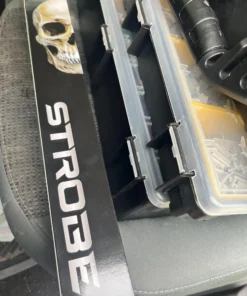
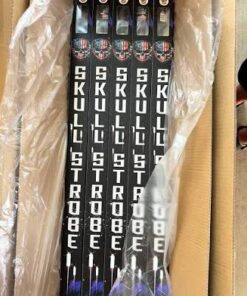
A strobe rocket is a single-flight device. It sits on a guide stick, lifts off from a launch tube or holder, climbs high, and bursts into stars that flicker on and off rapidly, creating a shimmering, twinkling effect. Where the gatling cake is about speed and volume close to the ground, the strobe rocket is about height and a single moment of sparkle.
Visual Effects and Light Intensity of gatling gun firework
The two products light up the sky in opposite ways. A gatling cake throws out many small effects in a sustained sweep, so the light is spread across a wide, low arc for the whole sequence. Strobe stars, by contrast, flash in bursts of bright white or coloured light that pulse against the dark, which can look striking even from a long way off.
Brightness per moment favours the strobe effect: each flash is sharp and attention-grabbing. Coverage over time favours the gatling cake, which keeps the sky busy rather than delivering one peak.
Acoustic Profiles and Audience Impact
This is where the gap is widest. A gatling cake is loud in a sustained way, a long rattle that lands in the chest and gets people cheering or flinching. A strobe rocket makes a whoosh on ascent and a burst at altitude, but the strobing itself is fairly quiet; many strobe stars give off a soft fizz rather than a bang.
Audience reactions follow. Rapid-fire cakes generate energy and noise, which suits parties and countdown moments. Strobe rockets draw a quieter “ooh” and tend to work better for families with young children or anyone sensitive to loud noise, including pets nearby.
Situational Use and Best Display Scenarios
Space is the first deciding factor. A gatling cake stays low and needs a stable, flat base plus enough clear ground around it for the sweep. A strobe rocket needs vertical clearance: no overhanging trees, power lines, or roofs above the launch point, and somewhere sensible for the spent stick to fall.
Here’s how they tend to suit common situations:
- Small back gardens: Often better for a compact, low-angle cake, provided the label’s safety distance actually fits your space. Rockets can drift and their sticks can land on roofs or in neighbouring gardens.
- Large fields or private land: Both work well. Rockets get room to climb, and cakes can be spaced out for a fuller show.
- New Year’s countdowns: A rapid-fire cake is ideal right at midnight, when noise and intensity match the mood.
- Mixed-age family gatherings: Strobe rockets or quieter cakes make for a gentler experience.
- Built-up neighbourhoods: Think carefully about noise. A long rattle late at night travels far.
If you’re building a sequence, a sensible pattern is to open with a few rockets, use the gatling cake in the middle to lift the energy, and save your biggest effect for last. Mixing the two types adds contrast that neither achieves alone.
Safety Protocols and Launch Site Requirements
Every consumer firework carries a stated minimum spectator distance on the label, and that number is the starting point rather than a suggestion. Rapid-fire cakes can be powerful, and rockets can travel unpredictably if a stick snaps or a gust catches them, so give both more room than you think you need.
Follow these basics for any launch:
- Check local laws first. Rules on permitted products, dates, and times vary by country, state, and town, and some areas ban aerial devices outright.
- Use a firm, level base. Place cakes on solid ground or a board, never on soft grass that could let them tip mid-sequence. A toppled cake fires sideways.
- Set rockets in a proper holder. Use a tube or launch rack angled slightly away from spectators, never a bottle or loose stake.
- Clear the area above and around. Check for trees, wires, vehicles, and dry vegetation before you start.
- Light at arm’s length and walk away. Use a proper lighter or portfire, keep your body out of line with the tubes, and never lean over a device.
- Never relight a dud. Leave a failed device for at least 20-30 minutes, then soak it in water before disposal.
- Keep water nearby. A bucket or hose should be within easy reach throughout.
Alcohol and fireworks don’t mix. Nominate one sober person to handle every ignition.
Choosing the Right High-Cadence Pyrotechnics
The two products answer different questions. A gatling gun firework delivers sustained noise, a sweeping wall of low-level light, and a burst of energy that suits midnight countdowns and lively crowds. A strobe rocket offers height, shimmering flashes visible from far away, and a gentler sound that sits better with families and quieter neighbourhoods.
When shopping for the best rapid-fire cake, read beyond the box art. Check shot count against stated duration to judge how fast it actually fires, look at the listed effects so you know whether you’re buying crackle, comets, or whistles, and confirm the safety distance works for your launch site. Buying from established retailers who stock certified products is worth the small premium.
If you have room for both, use them together: rockets for the opening and quieter stretches, the gatling cake for the moment you want everyone on their feet. That contrast is what makes an amateur display feel planned rather than random.
| GUN | 1 GUN, 3 GUNS, 5 GUNS, 10 GUNS |
|---|
Be the first to review “Gatling Gun Firework”
Related products
FIREWORKS
FIREWORKS

FIREWORKS
FIREWORKS
FIREWORKS
FIREWORKS

FIREWORKS
FIRECRACKER
Reviews
There are no reviews yet.