
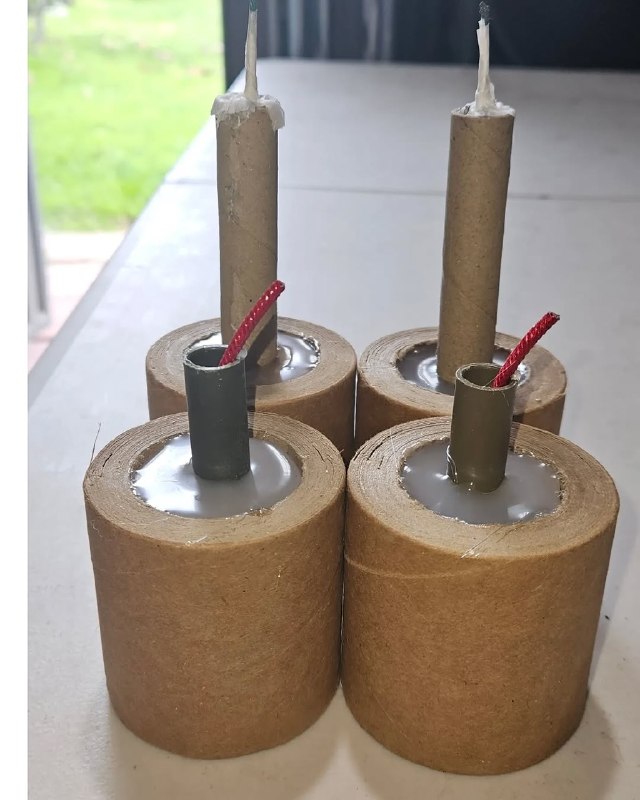
El Diablo Strobe Rocket

Price range: $90.00 through $550.00
A strobe rocket has three main jobs: get off the ground, climb in a predictable line, and deliver a payload that flashes on cue. Each job falls to a different part of the device, and the quality of the final effect depends on how well those parts work together.
How the El Diablo Strobe Rocket Lights Up the Sky

Most el diablo strobe rocket climb, pop, and fade. The ones people remember do something stranger: they hang in the dark and blink, a cluster of white or colored flashes that seems to stutter against the night sky like a faulty neon sign. That flickering signature is exactly what draws crowds to the el diablo strobe rocket, a firework built around a pulsating effect rather than a single burst of color.
If you have ever watched a strobe effect and wondered why it flashes instead of burning steadily, you are asking a better question than most spectators. The answer involves some surprisingly elegant chemistry, a carefully tuned motor, and a fair amount of physics that pyrotechnicians have refined over decades. Understanding how it works will change how you watch a show. It will also make you a safer and more thoughtful person to have standing near a launch rack, which matters more than any visual effect.
The Anatomy of the El Diablo Strobe Rocket
A strobe rocket has three main jobs: get off the ground, climb in a predictable line, and deliver a payload that flashes on cue. Each job falls to a different part of the device, and the quality of the final effect depends on how well those parts work together.
From bottom to top, a typical design includes a guide stick or fin assembly for stability, a motor tube packed with propellant, a delay fuse, and a header containing the strobe stars and a small burst charge. The delay is the quiet hero here. If it burns too fast, the stars open while the rocket is still climbing and smear across the sky; too slow, and the rocket has already tipped over and started falling.
Chemical Composition of the Strobe Effect
Strobe stars are the heart of the show. Unlike ordinary stars, which burn continuously, strobe compositions are formulated to oscillate between a dim smolder and a bright flash. Common formulations use metal fuels such as magnalium (a magnesium-aluminum alloy) paired with oxidizers like ammonium perchlorate, plus sulfur-bearing compounds that encourage the reaction to stall and restart.
Color comes from metal salts. Strontium compounds push the flash toward red, barium toward green, and sodium toward yellow-orange, while plain white strobes rely mostly on the brilliance of the burning metal itself. Getting a clean color and a reliable pulse at the same time is the hard part, because the additives that produce color can dampen the oscillation.
The High-Performance Motor and Tail Design
The motor is usually a compressed charge of black powder or a similar propellant pressed into a sturdy paper or composite tube with a narrow choke at the base. That choke works like a nozzle, accelerating the exhaust gases and turning a fast burn into usable thrust.
Many strobe rockets also include a tail effect, a visible trail of sparks during the climb. This is often created by adding coarse charcoal or metal particles to the motor composition. A good tail does two things: it builds anticipation, and it lets the audience track the rocket so their eyes are already in the right spot when the strobes open.
The Physics of the Pulsating Light Sequence
Why does a strobe star blink instead of glowing steadily? The short answer is that the burning surface keeps choking itself out and then reigniting.
As the star burns, a thin layer of molten slag and reaction products forms on its surface. This layer insulates the composition underneath and starves it of heat, so the burning slows to a dull smolder. Heat builds up beneath the crust until the material underneath reaches ignition temperature, at which point it flares violently, blows the crust away, and produces the bright flash you see. Then the cycle starts again.
The frequency of that cycle depends on several variables:
- Particle size of the metal fuel: finer powders tend to produce faster, more frequent flashes
- Ratio of fuel to oxidizer: small shifts can change the pulse rate noticeably
- Star size and density: larger, tightly packed stars often pulse more slowly
- Ambient temperature and humidity: damp or cold conditions can make the rhythm irregular
What looks like a single chaotic shimmer is really dozens of independent stars, each running its own flash cycle. Because they are slightly out of sync, the eye reads the combined effect as a crackling, twinkling cloud rather than a uniform blink. That slight randomness is a big part of why strobe effects feel alive.
Launch Dynamics and Flight Path
The moment the fuse reaches the motor, the propellant ignites and gases rush out through the choke. Thrust builds within a fraction of a second, which is why rockets seem to leap from the launch tube rather than lift off gradually.
During the powered phase, the rocket accelerates hard. Once the propellant is spent, it enters a coasting phase where momentum carries it upward while gravity and air drag slow it down. The delay fuse burns throughout this coasting stretch, timed so the header fires near the highest point of the arc.
Wind is the biggest outside factor in the flight path. Rockets with guide sticks tend to weathercock, meaning they turn slightly into the wind as they climb. A breeze that seems mild at ground level can be considerably stronger a few hundred feet up, so the burst point may drift well downwind of where you expected.
Achieving Maximum Altitude and Stability
Stability comes from keeping the center of pressure behind the center of mass. A guide stick or fins move the center of pressure rearward, so the rocket points into its own direction of travel instead of tumbling. A rocket that wobbles wastes energy and bursts low, which ruins the strobe effect and creates a safety risk.
Three practical habits help any rocket reach its intended height:
- Launch from a firm, level base with the tube or stick angled straight up, or very slightly away from spectators.
- Store rockets somewhere cool and dry so the propellant and strobe stars do not absorb moisture.
- Check that guide sticks are straight and securely attached before launch.
Visual Impact: Comparing El Diablo Strobe Rocket to Standard Rockets
Standard consumer rockets usually rely on one of a few payloads: a report (the loud bang), a burst of colored stars, or a crackling effect. They are bright and quick, but the payoff lasts maybe a second or two. A strobe payload stretches that moment out, because each star keeps flickering as it falls.
| Feature | Standard Rocket | Strobe Rocket |
|---|---|---|
| Payload effect | Steady color burst or report | Pulsing, flickering stars |
| Visible duration | Short, often a second or two | Longer, as stars blink on the way down |
| Audience focus | The burst moment | The lingering descent |
| Best use in a show | Fast rhythm, loud punctuation | Contrast, texture, slower passages |
The real strength of the el diablo strobe rocket in a display is contrast. Placed after a run of solid color bursts, a strobe effect looks almost electric. Overuse it, though, and the novelty wears off fast. The best amateur shows I have seen treat strobes like a spice: one or two well-timed moments rather than a constant feature.
Safety Protocols and Best Practices for Pyrotechnicians
Strobe compositions can be more sensitive than ordinary star mixtures, and the metal fuels involved burn extremely hot. That alone is reason to treat these rockets with extra respect, whether you are a licensed professional or a backyard hobbyist following local consumer firework rules.
Before you light anything, confirm what is legal where you are. Rules on aerial consumer fireworks vary widely by country, state, and even city, and some areas restrict rockets specifically because of their unpredictable landing zones.
On launch day, a few habits separate a good night from a trip to urgent care:
- Clear the area: keep spectators well back and upwind, and follow the minimum distances printed on the product label
- One device at a time: light a single rocket, step away, and never lean over a launch tube
- Handle duds carefully: wait at least 20 minutes before approaching a rocket that failed to fire, then soak it in water
- Keep water ready: a hose or full bucket should be within arm’s reach of the launch area
- Sober operators only: the person lighting fuses should have a clear head and steady hands
- Protect your eyes: safety glasses are cheap and strobe stars can fall back burning
Weather deserves its own mention. Dry grass, gusty conditions, or nearby structures should push you to reschedule. A strobe star still flickering as it reaches the ground can ignite brush, and the drift described earlier means the landing zone can be bigger than you think.
The Future of El Diablo Strobe Rocket Technology in Aerial Displays
Strobe chemistry has changed slowly over the past century, but the pressure to improve it is growing. Much of the research attention now focuses on reducing environmental impact, especially the perchlorates and heavy-metal colorants that can linger in soil and water after shows. Chemists have been experimenting with alternative oxidizers and colorants that keep the pulse sharp without the same residue.
Precision is the other big frontier. Professional displays increasingly use electronic firing systems that ignite effects to the fraction of a second and sync them to music. Pair that timing with strobe stars engineered for consistent pulse rates, and designers can create choreographed flicker patterns rather than random shimmer.
Drone light shows have also raised the bar for audiences. Some people see drones as competition for fireworks, but many producers now combine both, using drones for shapes and text and pyrotechnics for raw brightness, sound, and the physical sensation of a burst. Strobe effects fit naturally into that pairing because their flicker echoes the blinking LEDs overhead.
For anyone choosing or launching strobe rockets today, the takeaways are simple. The flash comes from a burning surface that repeatedly smothers and reignites itself, the climb depends on a well-built motor and a straight, stable flight, and the payoff works best when used sparingly against steadier effects. Treat the metal-rich compositions with respect, check your local rules, and plan your launch site around the wind rather than your favorite viewing angle.
Next time a strobe opens overhead, watch a single star as it falls. You are seeing a tiny chemical engine stalling and restarting dozens of times in a few seconds, and once you know that, the sky never looks quite the same.
| ROCKETS | 2 ROCKETS, 5 ROCKETS, 8 ROCKETS, 15 ROCKETS |
|---|
Be the first to review “El Diablo Strobe Rocket”
Related products
FIREWORKS
CAKES


FIREWORKS
FIREWORKS
FIREWORKS
FIREWORKS
Reviews
There are no reviews yet.