
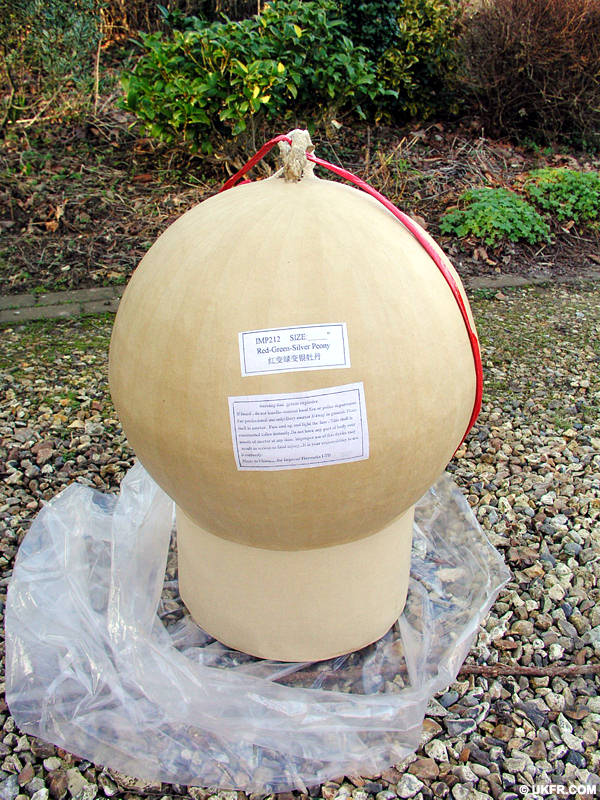


Very few people in any crowd have seen a 16′ display shell go up. Most professional displays top out at 8 or 10 inches, so a shell this size is rare even among people who work in the industry. When one does fire, the crowd usually goes quiet for a second after the break, and then the cheering starts.
This guide covers what makes a 16-inch display shell firework different from the rest of the show: how it’s built, what it looks and sounds like, why operators book them, and the safety work that makes firing one possible. It’s written for event planners weighing a big finale, pyrotechnic hobbyists who want to understand the craft, and anyone who has watched one of these open overhead and wondered how it works.
Engineering the Giant: Anatomy of a 16-Inch Shell
A 16-inch shell is not simply a 4-inch shell made four times bigger. Volume increases with the cube of the diameter, so a shell twice as wide holds about eight times as much material. At 16 inches, the shell is heavy enough that it has to be handled as structural equipment, not as a consumer product.
Internal Composition and Burst Charge Mechanics
Most large display shells use a spherical design, the Japanese-style construction known for producing symmetrical breaks. Inside the casing, hundreds or thousands of “stars” are packed in careful layers around a central burst charge. The stars are pellets of metal salts, fuel, and binder, and they produce the colors.
The burst charge has a hard job. It has to rupture a thick, multi-layered paper casing and throw the stars outward at the same speed in every direction. If the burst is too weak, you get a lopsided, sagging flower. If it’s too strong, the stars can be blown blind before they ignite.
Builders control this with:
- Burst composition: often coated rice hulls or similar carriers that spread the charge evenly
- Pasting layers: many wraps of kraft paper that build up casing strength so the pressure peaks before rupture
- Time fuse length: set so the shell breaks at the top of its arc, when it’s moving slowest
Launch Requirements and Mortar Tube Specifications
A shell this size is fired from a 16-inch mortar, usually heavy steel or thick-walled fiberglass. Mortars are buried or set in sturdy racks so they don’t tip during firing. The lift charge, typically black powder at the base of the shell, has to send a very heavy payload hundreds of meters up.
A common industry rule of thumb is about 100 feet of altitude per inch of shell diameter. That puts a 16-inch shell somewhere around 1,600 feet before it breaks. Firing is almost always electrical and remote, because nobody should be near the tube when it goes.
Unrivaled Visual Impact and Sky Coverage
The main reason to fire a 16-inch shell is scale. A rough guide used by display operators puts burst diameter at about 70 feet per inch of shell size. That suggests a spread of over 1,000 feet for a well-built 16-inch shell, wide enough to fill most of the sky that spectators can see.
That size changes how the audience watches the show. Smaller shells are seen as objects in the sky. A 16-inch break wraps around people’s view, so viewers on the edges of a large crowd see it nearly as well as those in the middle. For waterfront events and festivals spread across several kilometers, this coverage is a practical advantage, not just a visual one.
Height also helps. Because the break happens so high, buildings, trees, and hills block less of it. People watching from rooftops across town, or from boats several kilometers away, still get a clear view. A 6-inch shell fired from the same site might be blocked by the first high-rise in the way.
Effect choice matters at this scale. Brocade crowns, long-hanging willows, and multi-ring peonies (shells with concentric color layers) make the best use of the size. A cramped effect like a small crossette pattern can look strangely thin when it’s spread over that much sky.
Performance Review: The Sensory Experience of Large Caliber Effects
Judging a big shell means looking past “it was huge.” Experienced viewers and competition judges look at specific qualities, and the best 16-inch display shell firework designs perform well on each of them.
Acoustic Power and Decibel Analysis
You feel the sound before you think about it. There are two separate reports: the dull thump of the lift charge leaving the mortar, then several seconds later the break high overhead. With a 16-inch shell, the break is a deep, rolling boom more than a sharp crack. Low frequencies travel far, and many spectators say they feel it in their chest.
Exact decibel readings depend heavily on distance, weather, and the shell’s construction, so be skeptical of any single number you see quoted. What’s consistent is the delay. Sound travels about 343 meters per second, so someone a kilometer away sees the break about three seconds before they hear it. That gap adds to the drama, and good show designers plan around it.
Duration and Symmetry of the Break of 16′ display shell
Symmetry is the hardest test. A perfect break forms a sphere that keeps its shape as it grows. Lopsided gaps or clumped stars show a packing or burst problem, and at 16 inches any flaw is huge and obvious to the whole crowd.
Duration is where large shells really stand out. Bigger stars burn longer, and a well-made willow or kamuro (a glittering gold hanging effect) can stay visible for 8 to 10 seconds or more as it drifts down. That hanging time is what gets an audience gasping, not the first flash.
Strategic Advantages for Professional Pyrotechnic Displays
Why would an operator put a large part of a budget into one shell when the same money could buy dozens of smaller ones? Because one big shell can do things a barrage can’t.
A clear focal point. A show full of mid-size shells can blur together. A single large shell, fired alone after a deliberate pause, gives the show structure. Crowds remember it, and photos of it get shared.
Pacing control. Designers often use a big shell to mark the peak of the show or to reset the mood before the finale. The pause before it fires builds tension that a constant stream of fire can’t.
Reach across a big venue. As covered above, height and size let one shell serve an audience spread over a wide area. For city-scale celebrations, that efficiency is a real benefit.
Prestige and identity. Some festivals, particularly in Japan, are known for their large-caliber shells. Featuring one tells the audience the event is serious about pyrotechnic craft.
There are trade-offs. These shells are expensive, made by a small number of specialist manufacturers, and require much larger launch sites. One sensible tip for planners: book a 16-inch shell only when the site can hold the full safety distance. Firing one where a 10-inch shell would fit better adds risk without adding much to the show.
Safety Protocols and Exclusion Zone Logistics Of 16′ display shell
Everything about a 16-inch shell is decided by safety distance. In the United States, NFPA 1123 is the standard reference for outdoor displays, and its widely used rule sets a minimum spectator distance of 70 feet per inch of mortar diameter. For a 16-inch mortar, that’s 1,120 feet, or around 340 meters, in every direction. Many local authorities and operators require more.
That radius rules out most venues straight away. Practical sites tend to be:
- Fire barges anchored well away from shore
- Large open fields or reclaimed land
- Remote parts of beaches or harbors with controlled access
Beyond distance, a responsible operation covers:
- Licensed crew with experience firing large caliber shells
- Remote electrical firing with clear abort procedures
- Wind checks before firing, since debris and falling stars drift a long way
- Dud recovery plans, because an unexploded large shell is a serious hazard and must be handled only by trained technicians
- Coordination with local authorities, including fire services, police, and aviation authorities where airspace is involved
Malfunctions at this size are rare but serious. A shell that breaks low or inside the mortar releases a lot of energy close to the ground. This is why these shells belong only in professional hands, under permits, and never anywhere close to a backyard setting.
The Future Role of Heavy Artillery in Modern Fireworks
Drone light shows have taken over some events that used to rely on fireworks, especially in places worried about smoke, noise, or wildfire risk. Drones can draw logos and words in the sky that no shell can. That has led some people to predict the end of big-caliber fireworks.
That prediction underrates what a 16-inch shell provides. Drones are precise, but they can’t create the physical shock of a deep boom or a 1,000-foot glittering crown slowly drifting down. More and more shows in 2026 are combining the two: drones for storytelling and shapes, and a few large shells for the emotional peak. In that mix, the big shell matters more, not less, because it’s the part drones can’t copy.
Manufacturing is changing too. Makers are experimenting with lower-smoke compositions, biodegradable casings, and more consistent burst designs, all of which may make large shells easier to approve at sensitive sites.
For planners, the takeaway is simple. A 16-inch shell is a specialist tool: hard to site, expensive, and heavily regulated, but unmatched when the venue suits it. If you’re thinking about one for an upcoming event, start with the site survey, not the shell catalog. Confirm you can hold the full exclusion zone, then talk to an operator with large-caliber experience. Get those two things right, and you’ll fire the one moment from the night that people remember.
Be the first to review “16′ display shell”
Related products

FIREWORKS
FIREWORKS


FIREWORKS
FIREWORKS
FIREWORKS

CAKES
FIREWORKS

FIREWORKS
Reviews
There are no reviews yet.