
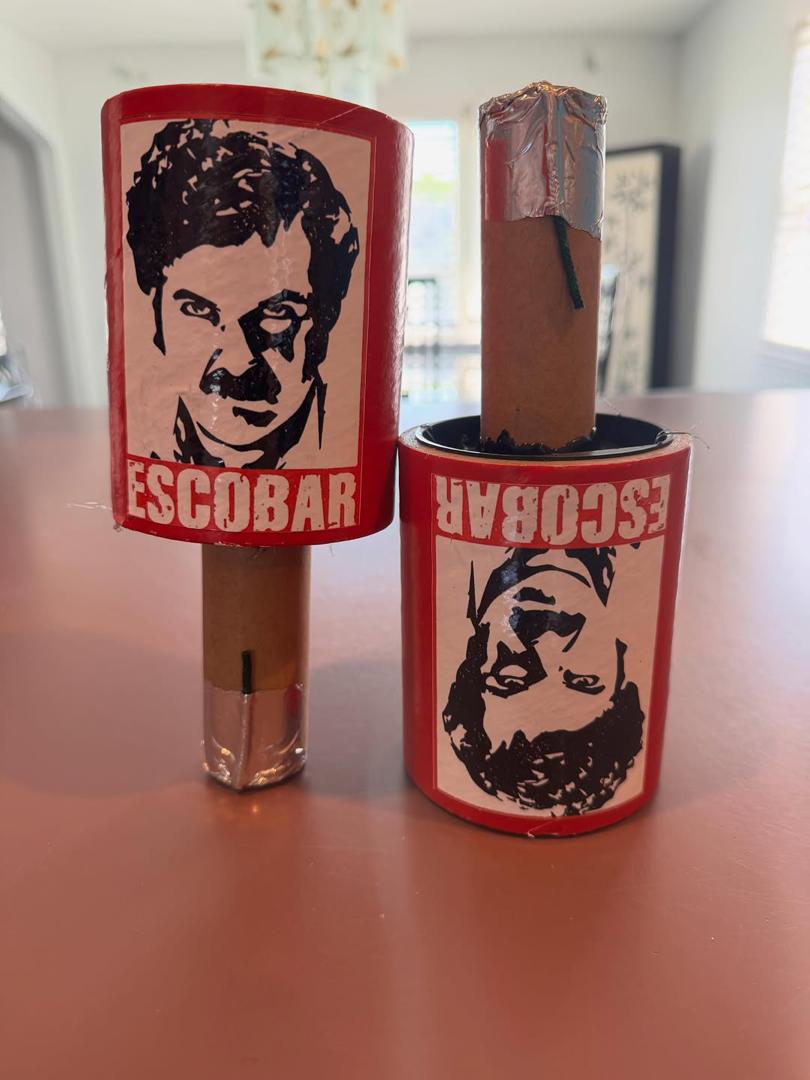
Escobar strobe rocket
Price range: $80.00 through $700.00
The reason people remember seeing an Escobar strobe rocket long after the show ends is that it attacks two senses simultaneously. The visual strobe creates a disorienting, almost hypnotic effect against a dark sky, while the percussive reports hit the chest with a physical thump. That dual-sensory assault is what separates a strobe rocket from a standard aerial shell or Roman candle.
Escobar strobe rocket
Few fireworks command attention the way a well-built strobe rocket does. Among the most talked-about consumer and professional-grade pyrotechnics in recent years, the Escobar strobe rocket has earned a reputation for delivering a mesmerizing pulsating light show paired with a thunderous report that can rattle windows from hundreds of feet away.
Whether you’ve seen one crack open the sky at a Fourth of July celebration or watched slow-motion footage online, the effect is unmistakable: a climbing trail of sparks followed by a rapid-fire sequence of blinding white flashes and concussive booms.
For pyrotechnic enthusiasts and professional show designers alike, understanding what makes this rocket tick – from its chemical composition to its flight dynamics – is essential for using it safely and getting the most dramatic visual payoff. This piece breaks down the science, the spectacle, and the safety considerations behind one of the most impressive rockets you can light.
Defining the Escobar Strobe Rocket and Its Unique Composition
The Escobar strobe rocket belongs to a class of aerial pyrotechnics designed to produce a repeating flash-and-bang sequence rather than a single burst. What sets it apart from a standard bottle rocket or single-shot aerial is the multi-stage payload packed into its warhead.
Each stage contains a carefully measured charge that ignites in rapid succession, creating the signature strobe pattern. The casing is typically constructed from heavy-duty cardboard or fiberglass tubing, reinforced to withstand the internal pressures generated during flight and detonation.
The rocket’s overall length ranges from about 18 to 30 inches depending on the variant, with the payload section accounting for roughly 40 percent of that length. Weight varies, but most versions fall between 6 and 12 ounces fully loaded. That weight-to-thrust ratio matters enormously for altitude and stability, which we’ll get into shortly.
The Chemistry of the Escobar strobe rocket Effect
Strobe compositions rely on a specific interplay between fuel, oxidizer, and a catalyst that creates a self-oscillating chemical reaction. The most common formulation uses magnalium (a magnesium-aluminum alloy) as the fuel, combined with an oxidizer like barium nitrate or potassium perchlorate. A small percentage of a dark pyrotechnic compound – often a sulfur-based mixture – acts as the “off” phase, temporarily quenching the reaction before it reignites.
This on-off cycle happens because the combustion alternates between two distinct chemical pathways. One pathway burns bright and hot, producing the visible flash. The other burns cooler and darker, producing gas and heat that prime the next ignition.
The frequency of the strobe – typically 3 to 8 flashes per second – depends on the grain size of the magnalium, the ratio of fuel to oxidizer, and the density of the pressed composition. Even small changes in humidity during manufacturing can shift the flash rate, which is why quality control in strobe compositions is notoriously finicky.
Propulsion Mechanics and Flight Stability Of Escobar strobe rocket
The propellant grain in the Escobar strobe rocket is a pressed black powder or composite charge seated in the tail section. A clay nozzle at the base constricts the exhaust, generating thrust as hot gas escapes at high velocity. Most variants use a core-burning grain, meaning the propellant burns from the inside out, which provides a more consistent thrust curve than surface-burning designs.
Stability during ascent comes from a combination of the guide stick (the long wooden dowel attached to the rocket body) and the fin effect created by the stick’s drag. The center of pressure must sit behind the center of gravity for the rocket to fly straight.
If the stick is too short or the payload too heavy, the rocket corkscrews or tumbles. Manufacturers typically calibrate stick length to roughly three times the body length, though some professional-grade versions use small plastic fins instead of a stick for a cleaner trajectory.
Visual and Auditory Impact of the Strobe Sequence
The reason people remember seeing an Escobar strobe rocket long after the show ends is that it attacks two senses simultaneously. The visual strobe creates a disorienting, almost hypnotic effect against a dark sky, while the percussive reports hit the chest with a physical thump. That dual-sensory assault is what separates a strobe rocket from a standard aerial shell or Roman candle.
The Pulsating Light Frequency
Human eyes are most sensitive to flashing light in the 4 to 8 Hz range, and most strobe rockets are tuned to land squarely in that window. At 5 Hz, each flash lasts roughly 100 milliseconds with a 100-millisecond dark interval. That’s fast enough to feel relentless but slow enough for the eye to register each individual pulse as a distinct event.
The color temperature of the flash skews heavily toward blue-white, typically in the 6,000 to 8,000 Kelvin range. That’s close to daylight color temperature, which is why the flashes feel so piercing against the warm oranges and reds of other fireworks.
Some newer formulations incorporate trace amounts of copper compounds to push the flash toward a slightly green-white hue, but the classic Escobar composition stays in the pure white spectrum. At peak altitude – usually between 150 and 300 feet – each flash can illuminate the ground below like a camera strobe, casting sharp, momentary shadows.
The Decibel Level and Sonic Boom Effects
Sound is half the experience. Each flash is accompanied by a sharp report generated by the rapid expansion of gas during the combustion pulse. Measured at 100 feet, individual reports typically register between 130 and 145 decibels, which puts them in the same range as a gunshot or a jet engine at close distance. The rapid succession of these reports creates a rolling, machine-gun-like sound that’s distinct from the single boom of a salute shell.
The acoustic signature also carries well because of the altitude at which the strobe fires. Sound radiating from 200 feet up encounters fewer ground-level obstructions, so the reports travel farther with less attenuation. In calm conditions, the strobe sequence from a single rocket can be heard clearly at distances exceeding half a mile. Residents near professional display sites often report that strobe rockets are the single loudest element of any show.
Strategic Use in Large-Scale Pyrotechnic Displays
Professional pyrotechnicians don’t just fire strobe rockets randomly. They’re placed at specific moments in a show’s timeline for maximum psychological impact. A common technique is using a volley of strobe rockets as a “pattern interrupt” – a sudden shift in tempo that snaps the audience’s attention back after a slower, more colorful segment.
Pacing and Rhythm in Show Design
Show designers think about fireworks the way a music producer thinks about a track. You need builds, drops, quiet moments, and crescendos. Strobe rockets serve as percussive accents, the snare hits in a symphony of color.
Firing three to five simultaneously creates a wall of flashing light that functions as a visual climax before transitioning into a softer segment of willows or chrysanthemums.
Timing matters down to the fraction of a second. Most professional shows in 2026 use electronic firing systems synced to music, and strobe rockets are typically cued to land on a downbeat or a dramatic pause in the soundtrack.
The delay between ignition and the start of the strobe sequence – usually 3 to 5 seconds of flight time – has to be accounted for in the choreography. Miscue a strobe rocket by even two seconds and it flashes during the wrong musical phrase, breaking the emotional arc of the segment.
Some designers also use staggered launches, firing strobe rockets at half-second intervals to create a cascading effect across the sky. This technique works particularly well over water, where reflections double the visual intensity.
Safety Protocols and Regulatory Considerations
A pyrotechnic that produces 140-decibel reports and burns at thousands of degrees demands serious respect. The Escobar strobe rocket, like all high-powered aerial fireworks, is regulated at federal, state, and local levels in the United States, and similar frameworks exist in the EU, Canada, and Australia.
Launch Clearance and Minimum Distance Requirements
The National Fire Protection Association’s NFPA 1123 standard governs outdoor fireworks display safety. For rockets of this class, the minimum spectator distance is typically 300 feet, though many jurisdictions require 500 feet or more depending on the shell equivalent weight of the payload. The launch site itself must be clear of overhead obstructions – trees, power lines, buildings – within a radius equal to the rocket’s maximum altitude.
Wind speed is a critical variable. Most permits specify a maximum surface wind of 20 to 25 mph for rocket launches. Above that threshold, the risk of erratic flight paths increases significantly. Professional crews monitor wind conditions continuously and will pull strobe rockets from the show lineup if gusts exceed safe limits.
Storage and Handling of High-Grade Pyrotechnics
Strobe compositions are classified as 1.3G explosives under Department of Transportation regulations, meaning they require a Type 2 or Type 4 magazine for storage. These magazines must be constructed of fire-resistant materials, kept locked, and situated specific distances from inhabited buildings based on the net explosive weight stored inside.
Handling protocols include grounding all personnel to prevent static discharge, keeping compositions away from open flame and heat sources, and never attempting to relight a misfired rocket.
A misfire protocol for strobe rockets typically involves waiting a minimum of 15 minutes before approaching, then soaking the device in water for disposal. The magnalium in strobe compositions is particularly sensitive to moisture during storage but can react violently if a damaged casing allows water contact with a partially burned charge.
The Future Evolution of High-Intensity Rocketry
Pyrotechnic engineering is not standing still. Manufacturers are experimenting with new strobe formulations that reduce heavy metal content – particularly barium – in response to tightening environmental regulations across Europe and parts of North America.
Nitrogen-rich compounds and bismuth-based oxidizers are showing promise as cleaner alternatives that maintain the intense flash output audiences expect.
Electronic integration is another frontier. Some 2026-era rockets incorporate small onboard igniters that allow each strobe pulse to be triggered wirelessly rather than relying on the self-oscillating chemical reaction.
This gives show designers precise control over flash timing, enabling synchronization accuracy within 10 milliseconds. The tradeoff is cost: electronically fired strobe rockets run roughly four to five times the price of traditional chemical-only versions.
Whether you’re a backyard enthusiast researching your next purchase or a licensed pyrotechnician planning a municipal show, the Escobar strobe rocket remains one of the most dramatic tools in the aerial fireworks arsenal.
Its combination of blinding light, chest-thumping sound, and precise tunability makes it a centerpiece effect that few other pyrotechnics can match. Respect the chemistry, follow the safety protocols, and you’ll put on a show people talk about for years.
| PIECE | 1 PIECE, 2PIECES, 3PIECES, 6PIECES, 10PIECES BOX |
|---|
Be the first to review “Escobar strobe rocket”
Related products

Uncategorized
Uncategorized
Uncategorized
Uncategorized
Uncategorized
Uncategorized

Uncategorized
Uncategorized
Reviews
There are no reviews yet.